
Having Your Reception at a Rented Home? Plan the Power, Weather, and Neighbors
By DJ Nate Burgoyne
If you’re having your wedding reception at a rented home, whether that’s a private residence or an Airbnb, the thing you’re most likely to underestimate is the weather. Close behind it is the power.
A reception at a rented home can be such a fun party. It’s private, it’s relaxed, and it feels personal. I want to share what I’ve seen so you can sort a few pieces out before the day instead of during it.
Weather comes first at a backyard wedding reception
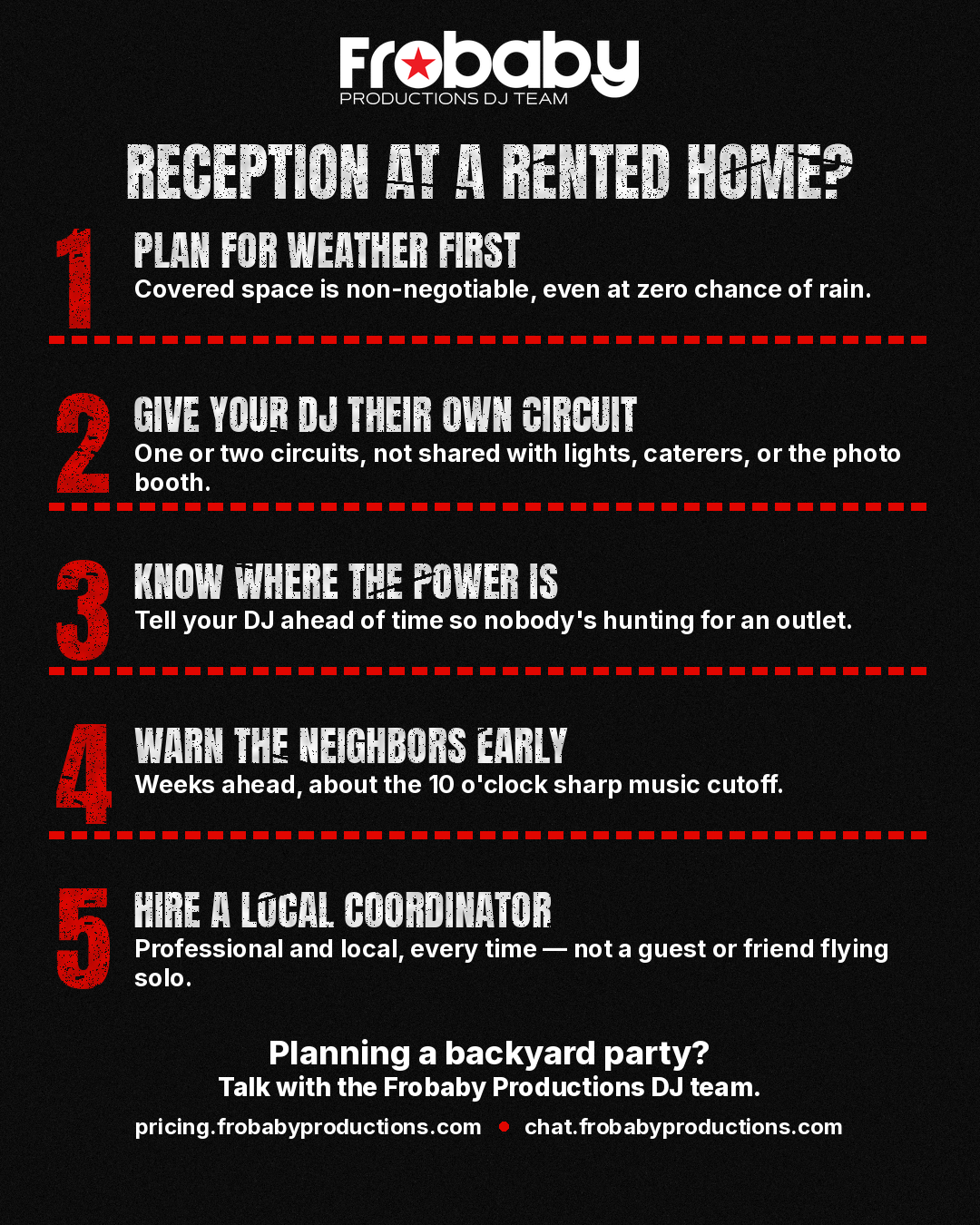
Weather contingencies are what people underestimate most at a home reception. Whatever your plan is for a nice day, you need a real plan for when the weather doesn’t cooperate, and you need it before the wedding.
From the DJ side, covered space is non-negotiable no matter what — even when the forecast says zero chance of rain. Hawaiʻi is the rainbow state. Sun showers can show up from clouds you can’t even see.
Here’s the minimum that actually protects the gear: a 10×15 tent (the Frobaby Productions DJ team can provide one), or a 10×10 with removable side walls. Removable matters. Rain blows onto equipment with an open 10×10, and with the sides left up it’s an oven when it isn’t raining. The gear goes in the middle.
A covered lanai can work, but a high roof does not. The breeze drives water in, and one drop can short the system. Market umbrellas and beach umbrellas do not protect a DJ at a reception. (For ceremony, I bring my own umbrella and don’t need you to provide one.)
These requirements aren’t about convenience. They’re in your best interest. If the equipment gets wet, there’s no music, no toast, no mic, no background or dance music, and no dance lights. It’s over.
Give your DJ their own circuit
This is the one that catches people off guard. At a backyard venue, you can easily underestimate how much electricity your vendors need.
Your DJ typically needs one or two circuits that aren’t shared with anything else. That means you can’t run the yard lights on the same outlet as the DJ. You also can’t hand the DJ’s outlet over to the caterers or the photo booth. DJ equipment is power-hungry, even the most basic setup.
So here’s what you need to do. Make sure your DJ has their own electrical circuit, know where that circuit is, and tell your DJ ahead of time. That way they’re not hunting for power when they arrive, or having an awkward conversation with the homeowner about running a cord out a window.
Warn the neighbors weeks ahead
There’s a noise ordinance with a music cutoff at 10 o’clock sharp. Let your neighbors know about your party, and the cutoff, weeks ahead of time. If you don’t, and someone complains, the police respond to complaints, and that’s not how you want your night to go.
Decide who’s actually in charge on the day
When a friend or family member is coordinating, it can get stressful fast. They’re trying to help, but often there’s no clear decision-maker, and the bride ends up deciding logistics while she’s in the middle of getting ready. That’s not where you want your head to be on your wedding day.
Hire a professional local coordinator. Every time. Local matters because they understand weather changes, they know the vendors — who’s late, who’s on time, who’s dependable — they understand the venues, the flow, and the challenges, and they’re dedicated to the day 100%.
A guest or friend coordinator usually doesn’t know those things. They don’t understand Hawaiʻi-specific needs — cake melting in the sun is a real one — they get distracted by people they know, and they usually operate alone. That’s a big mistake.
Talk with the Frobaby Productions DJ team
If you’re planning a backyard reception on Oʻahu, the Frobaby Productions DJ team would love to hear about your plans. We’re super transparent about our pricing, and you can see all of our packages at pricing.frobabyproductions.com. If you’d like to talk it through, grab a zero-pressure, ask-me-anything chat with the Frobaby Productions DJ team at chat.frobabyproductions.com.
What do people underestimate most about a backyard wedding reception?
Weather contingencies. Whatever your plan is for a nice day, have a real plan for bad weather before the wedding day.
What weather backup does a DJ need at a backyard reception?
Covered space is non-negotiable even at zero chance of rain. The minimum is a 10×15 tent, or a 10×10 with removable side walls, with the gear in the middle. A covered lanai can work; a high roof does not. Market or beach umbrellas do not protect a DJ at a reception.
How much power does a DJ need at a backyard wedding?
Your DJ typically needs one or two circuits that aren’t shared with anything else. DJ equipment is power-hungry, even the most basic setup.
What should you tell your DJ about power before a home reception?
Make sure your DJ has their own circuit, know where it is, and tell your DJ ahead of time so they aren’t hunting for power when they arrive.
Should you tell your neighbors about a backyard wedding?
Yes. Let them know about your party and the music cutoff, which is 10 o’clock sharp under the noise ordinance, weeks ahead of time. If someone complains, the police respond to complaints.
Should you hire a coordinator for a backyard wedding reception?
Hire a professional local coordinator. Local coordinators understand weather changes, know the vendors, understand the venues and flow, and stay dedicated to the day. A guest or friend coordinator is usually distracted, often works alone, and may not know Hawaiʻi-specific needs.